
Shadows That Eat the World
September, 21, 2026
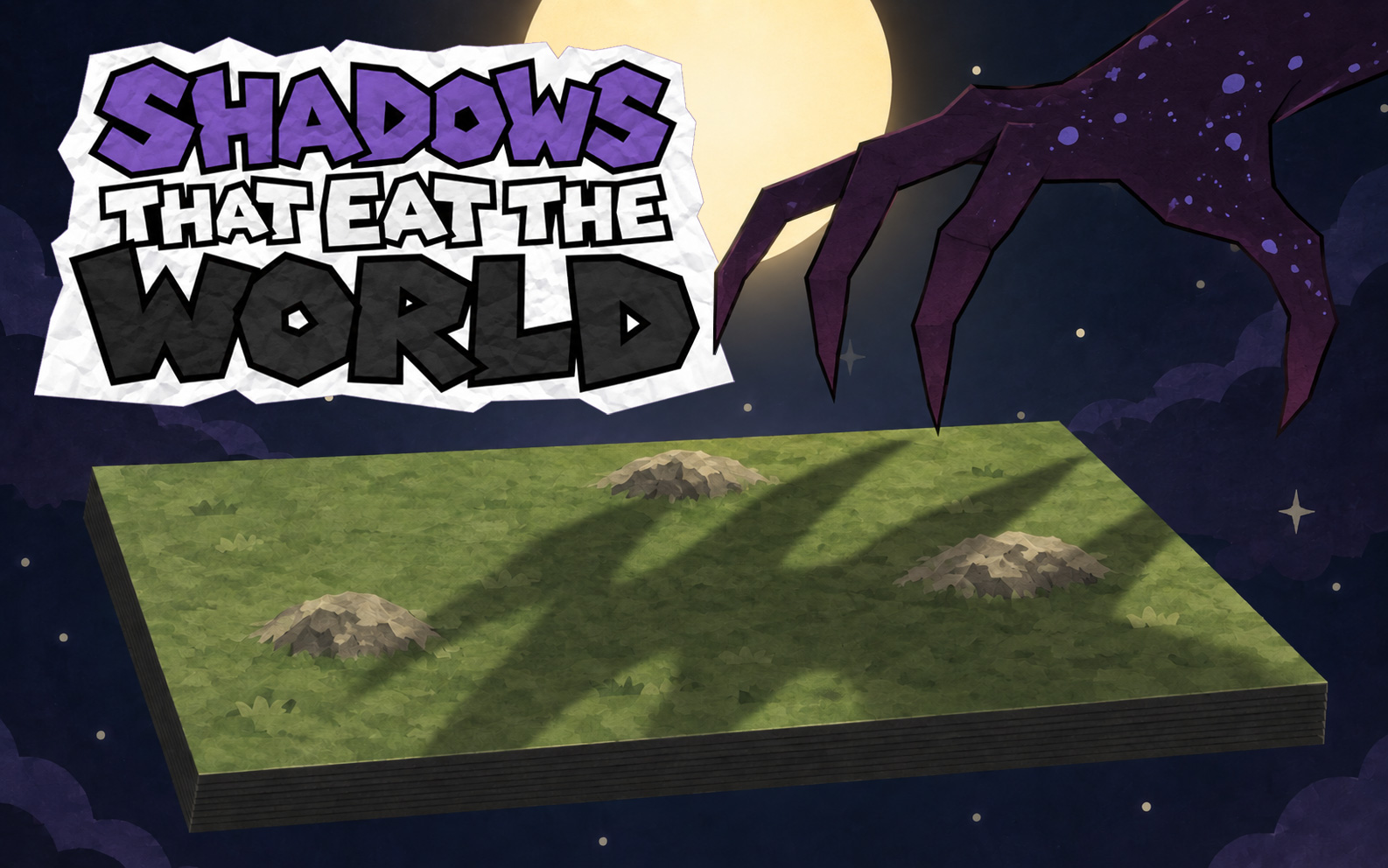
Entry 1 of building the Unknown World, a D&D world that is actually flat.
What is the most terrifying thing about a world that is truly flat?
When I set out on this journey, I thought it would be the edge. Falling off of it and into oblivion. But it turns out the greatest fear is something far simpler. Something the people of such a world would live with every single day. Shadows at dusk that eat cities, fields, and oceans, with fables, myths, and whole gods built to explain them. Shadows cast by something no one can see.
For those just joining
I've been running D&D games for a decade as of this year, telling stories inside a world I built myself. After three campaigns, hundreds of sessions, and a thousand hours of memories and lessons learned, I wanted to challenge myself to build a new world for our fourth campaign. And do it in the open to share the chaos it entails and all the lessons I've learned along the way and can finally put into place.
The first one of course being: choosing one thing that is different about this world from the one we inhabit. One shall be the number of the things, and the number of the things shall be one. Two shalt thou not count. Five is right out.
Why? Because it forces you to focus all the creativity you have on one central spot. A seed of an idea that everything else can latch onto and grow from. And for me, that one thing is: The world truly is flat. Now let's see where we end up.
Let's set the world table
The first step of building a world is making the map, and the first step of making a map is setting down the mountains, which then create the rivers. The rivers then the forests. The forests then the towns. Or so it usually goes except this time we're starting one level up from that. The actual world and cosmos itself... well, part of the cosmos.
So let's plop a big ol' table down. An egregiously large one. And put a large orb in the sky directly above it as our sun.
Fantastic. A world that no longer has need of any timezones or daylight savings time. Thank the heavens.
ahem carrying on... we now need a day and night cycle. Well, "need" isn't necessarily correct, but it's far too ingrained in the human psyche, and in my players, to go without. And who doesn't love a good ol' heist in the middle of the night?
So how are we going to do it? Have the table revolve around the sun? Maybe go geocentric instead? Both sound rather boring to me. Let's have a god literally spin the table like a rotisserie chicken instead, where one full "spin" is equivalent to a day. Problem solved.
Here come the shadows...
Now before we put more of our own creative energy into this world, I want to see what it has already given us back. The best stories are those that tell themselves. And the best worlds are those that write themselves into existence after all.
So let's make this table look a little more like a world by adding temporary hills, valleys, and mountains. And then, put ourselves in the shoes of a young boy down there, watching the day unfold.
You live in a little house on a hill overlooking a beautiful, grand landscape, and you're outside in the yard having a ball of a time. Shadows are not something you think particularly strongly about. They act exactly as they would here on Earth. Nothing strange about them at all.
But as evening comes, something you cannot see begins to eat the sun. Jagged marks like teeth bite into it from the bottom. At the same time, the farthest land you can see goes dark. And the dark is moving towards you. Slowly, at first.
You ignore it for a moment, going back to play. But when you blink, the last of the sun is gone, and the darkness has reached you. More startling still, your neighbor on the next hill over is still in the perfect light of golden hour. Not having seen the same sights you saw. Not being covered in the same darkness that you are.
Now let's step back out of the boy's shoes.
What ate the sun?
Quick disclaimer: we're about to get exceptionally nerdy. When I set out to see what would happen here, I did not anticipate in the slightest that I'd be hunting through NASA's website, or spending a full night going back and forth with Fable, all to answer a question I thought was simple. How far does the shadow run? How fast? And can you see the thing casting it, if the world is flat? The short answer is no. But I guess that just means our one thing was a pretty good thing to hinge on.
Imagine watching a large cruise ship sail off into the distance. As you wave goodbye from the pier, the ship gets smaller and smaller until it almost seems to sink. What disappears from your vision first is the bottom of its hull, then its midsection, then the very top, until it is completely gone from view. We know it did not sink. It's the curvature of the Earth that is preventing our eyes from seeing it.
Mountains in our world do the very same thing. When far enough away, they sink below the horizon, and the shadows they cast sink along with them. But that is not so in a flat world such as this. There is no horizon for anything to sink beneath. So a mountain a hundred miles away will still block the light, and cast a shadow for hundreds of miles, if not more.
Which begs the question. If nothing ever sinks, why can't the boy see the mountain?
Because there is a second thing at play here, called atmospheric extinction. (You could call it atmospheric scattering, but extinction sounds a lot more cool, so we're going with that.) Have you ever noticed, looking at a mountain or a skyscraper from far away, that it takes on a bluish tint? And that if it's far enough, it seems to vanish entirely from sight before it ever sinks below the horizon? That is extinction.
We think of air as clean. Nothing inside of it. A void, for all practical purposes. But over the course of a hundred miles there is a great deal inside of the air. Dust. Smoke. Water. Countless tiny particles, and light has to make its way through and around all of them. Some of them block a ray of light outright. Others scatter it off in different directions. Eventually the light that came from the mountain is overtaken by the light of the sky itself. Which is why the mountain goes blue, and then goes away.
So this poor boy, in a world not advanced enough to know any of this, will be attacked by the shadows of things he cannot see. Until the sun paints their edges by vanishing behind them.
The first gods
Now, how does the young boy cope with this? And what do his parents tell him, when they have no idea why it happened either? Is their land cursed, and their neighbor's blessed? What would they reach for to explain the unexplainable?
Surely there must be a god of the day, and a god of the night. And the shade... their offspring, born of the two fighting. Though in reality, all three are one. The one that spins the world.
The shadows themselves become proof of cursed land. Cartographers draw maps with the shadow lines marked, to guide adventurers away from the gods' cursed offspring. Cities grow districts and walls that follow these same lines, and the rich and poor are separated by who is able to hold the light longer than others.
The list goes on. We have changed one thing about this world, and it has given us the beginnings of a Greek mythos without our having to engineer much of it ourselves.
We still have much to do. Seasons do not yet exist in this world, and I wish for them to. The oceans and mountains still need setting down. And as I'm sure at least one of you has noticed... we have an entire underworld too.
We could have rushed ahead to all of that. And we would have missed something beautiful.